
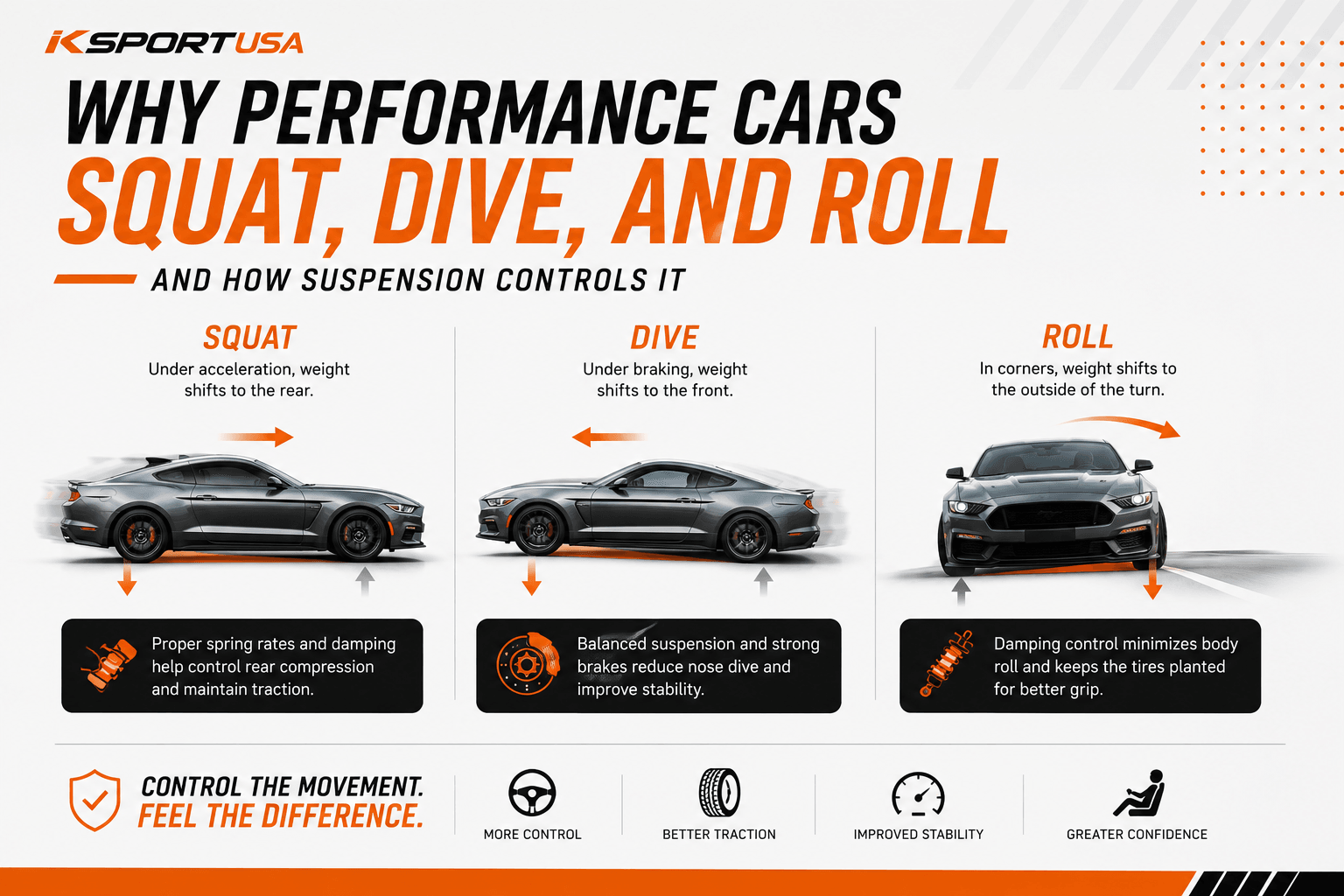
A performance car is constantly shifting its weight.
Accelerate hard and the rear of the car appears to squat. Hit the brakes and the nose dives forward. Enter a corner quickly and the body leans toward the outside of the turn.
These movements are normal results of weight transfer, but how effectively the suspension manages them can dramatically change the way a car feels and responds.
Whether you drive a Ford Mustang , Honda Civic Type R , Subaru WRX , Toyota GR86 , or BMW M3 , understanding squat, dive, and body roll can help you make smarter suspension choices.
Links from this passage:Why Cars Squat During Acceleration?
When a car accelerates, load transfers toward the rear tires.
This can make the rear suspension compress while the front becomes comparatively unloaded, creating the familiar squatting motion.
A powerful rear-wheel-drive car such as a Ford Mustang may make this movement especially noticeable under hard acceleration. Some weight transfer can help traction, but excessive suspension movement can make the chassis feel less controlled.
Links from this passage:Proper spring rates and damping help manage how quickly the suspension responds without attempting to eliminate normal weight transfer entirely.
Why the Nose Dives Under Braking?
Braking creates the opposite effect.
As the vehicle slows, load transfers toward the front tires. The front suspension compresses while the rear becomes comparatively unloaded, causing the nose to dive.
On performance cars such as the Honda Civic Type R or BMW M3 , controlling this movement can contribute to a more composed feeling during aggressive braking and corner entry.
Links from this passage:Suspension and brakes also need to work together. A Ksport Big Brake Kit can be part of a complete performance setup when paired with properly selected tires and suspension components.
Links from this passage:What Causes Body Roll in Corners?
Turn into a corner and load shifts toward the outside tires.
The body naturally rolls as the suspension responds to cornering forces. Excessive roll can make steering transitions feel slower and reduce the driver’s sense of connection with the chassis.
Cars such as the Toyota GR86 , Subaru WRX , and Nissan 350Z can benefit from suspension tuning that manages body movement while maintaining useful tire contact and suspension travel.
Links from this passage:The goal is not necessarily zero body roll. Controlled movement is what matters.
Damping Plays a Major Role…
Springs support the vehicle and influence how much the suspension moves, while dampers control the rate of that movement.
This relationship is why simply installing extremely stiff springs does not guarantee better handling.
Ksport Kontrol Pro Coilovers provide adjustable damping, giving enthusiasts the ability to fine-tune suspension behavior according to their vehicle, road conditions, and driving goals.
Links from this passage:The right setup can help the chassis feel more composed during acceleration, braking, and directional changes.
Street Cars Still Need Suspension Travel…
A suspension setup should control movement without making the car unnecessarily harsh.
A daily-driven Subaru WRX or Honda Civic Si still needs enough suspension travel to handle bumps, uneven pavement, and changing road surfaces.
Links from this passage:Excessive stiffness or lowering can reduce the suspension’s ability to respond effectively to those conditions.
That is why a good street-performance setup focuses on balance rather than simply making everything as stiff as possible.
Control the Movement, Not Just the Car!
Squat, dive, and roll are all part of vehicle dynamics. The objective of performance suspension is to manage those movements in a predictable and controlled way.
At Ksport USA , adjustable suspension solutions allow enthusiasts to tune their vehicles around their driving goals, whether that means improving a daily-driven Honda Civic , sharpening a Toyota GR86 , or building a more capable Ford Mustang .
Links from this passage:When the suspension manages weight transfer effectively, the result is a car that feels more stable, responsive, and connected to the driver.